|
Disclaimer: The views and opinions expressed in these articles are those of the authors and do not necessarily reflect the official policy or position of Wrestling-Titles.com or its related websites.
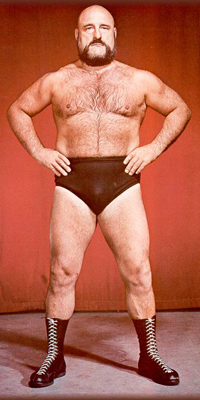
Maurice Vachon,
the Original Mad Dog... |
With Yvon Robert's retirement, it was obliously clear that pro wrestling in Québec would go into a hiatus: new wrestlers had to find new gimmicks to bring the fans into the arena. Two more events would affect the success that pro wrestling had in the past 25 years. In 1961, shortly after winning the championship belt, Johnny Rougeau went into semi-retirement to run a night club in Montéal with his brother Jacques. Then in 1963, promoter Eddy Quinn died. Since his death, pro wrestling was going almost nowhere. Local talents would go elsewhere, like Mad Dog Vachon who went to Minnesota and win the AWA title in 1964 and Edouard Carpentier, who went to Japan and Alberta to gain more success. With this kind of degradation, the wrestling business was nothing but back to the drawing board.
Meanwhile, Johnny Rougeau had success with his night club, the Mocambo, in east end Montéal. It hosted the top artists at the time and was also one of the last profitable night clubs in the now TV era. However, TV and expensive salary demands by some artists forced Rougeau to sell the business, and analysing what's happened in the local wrestling business lately, he would don the tights again and bring back the crowds.

Johnny Rougeau
The Champ who saved
wrestling in Québec |
He created a company called "Eastern Sports Entreprises", to whom he gave promotion rights to wrestling buddy Bob "Legs" Langevin under the name "All-Star Wrestling". He established office in a less expensive venue, the Paul-Sauve Arena, in Rosemont district northeast of Montéal. Remembering the impact TV gave to Eddy Quinn's promotion, he contacted Roland Giguère from Télé-Métropole (today the national TVA French network) to produce a weekly pro wrestling show called SUR LE MATELAS (will be presented later at CTV's affiliate CFCF 12 as Superstars of the Mat...). This show was extremely popular on Saturday afternoon, enough that the publicity representative who sold publicity spots on the program was sold out for weeks ahead !
The Paul Sauvé-Arena would become the main venue for regular shows, but the Forum would be used for special events during holidays like Easter, Thanksgiving and Christmas...
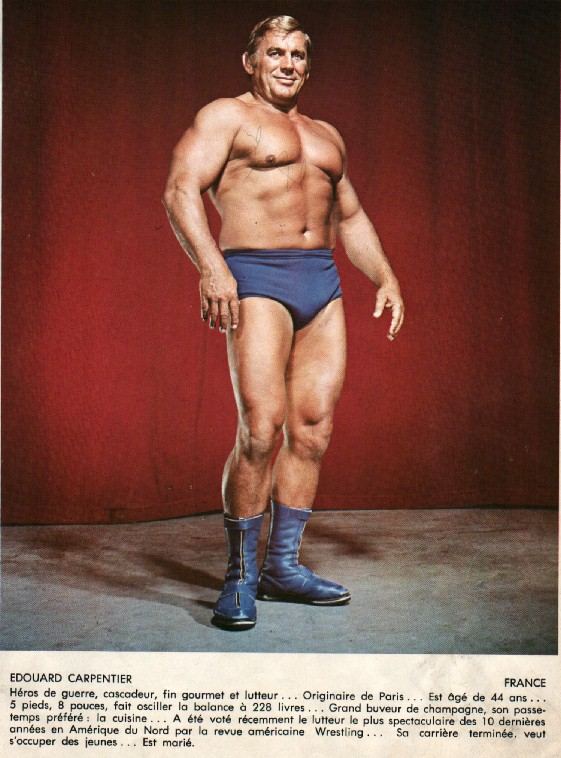
Édouard Carpentier
One of the greats... |

Don Leo Johnathan
A giant among the heels... |
With this new boom, new faces would come around, like Gino Brito, Gilles Poisson, Neil Guay, Tony Parisi, Johnny War Eagle, and heels like The Sheik, The Cuban Assassins and Abdullah the Butcher. Sooner or later, the vets of the former promotion came back: Maurice Vachon, Wladek Kowalski, Don Leo Johnathan, Edouard Carpentier and Tony Baillargeon. As well, a new breed of wrestlers has become popular: midget wrestlers, introducted by Gino Brito's father Jack Britton. Among the pint-sized athletes were Little Beaver, Sky Low Low and Little Brutus...

Eddie the Brain Creatchman
Manager of Champs... |
In the 60s, a new kind of caracter came into the scene: unlike the masked men of the 50s, mobster-like men accompanies his employee and roamed around the ring to interfere in the match so their protégé-would win: the wrestling manager. Most of the time a manager of heels, he is the person in charge of the talking, while the employee does the hard work. One of the most successful managers would be Eddy Creatchman, alias The Brain or The Boss. A referee who had his ways with wrestlers (he's the one lifting Johnny Rougeau's arm in victory over Hans Schmidt in a championship bout), Creatchman decided to put his mouth where the money is. He hired the most brutal heels ever to come into a ring (The Sheik and Abdullah the Butcher) and once a week, delivered one of his devastating speeches to the public. With a mobster-like voice, no matter he attracted lots of people in the arena, as well as his illegal actions like bearing an electric cattle rod on the opponents and a whistle to tell the protégé-to go at it...
If wrestling came back from the ashes, Johnny Rougeau did save it from total indifference...
Next chapter: A Rise, then another fall in the 70s
Copyright © 1999, Productions Leduc 2000
ltd, Montrèal, QC.
|


