|
Disclaimer: The views and opinions expressed in these articles are those of the authors and do not necessarily reflect the official policy or position of Wrestling-Titles.com or its related websites.
Gama Pehlwan & Imam Bakhsh
by Farid Azam
The pre-partition India produced so many good
wrestlers. During the past wrestling was sponsored by the Indian Rulers. The
champion wrestler, Great Gama (1878-1960) and
his younger brother Imam Baksh (1883-1977), were the sons of Wrestler
Aziz Baksh. Aziz Pahalwan devoted his life to the sport of wrestling in India
and fought many matches. Wrestling has
always been a famous sport in Indo-Pakistan form several thousand years old. In
ancient times, it was trained for combat and self-defense. Archeological
findings, dating back to 3000 B.C., indicated many enduring legends describing
the Gama wrestling bouts between between human and the supernatural. In feudal
times, wrestling matches were often fought to the death. The
wrestlers were admired, respected and heavily rewarded. All the requirements,
rations and miscellaneous expenses of the wrestlers were Bourne by the heads of
State to promote wrestling in their country. Wrestler Aziz Baksh (the Grand
father of Bholu Pahalwan) initially started his career in Amritsar. But then
proceeded to the State of Datia in Central India, where the ruler, Maharaja
Bhawani Singh employed him. Unlike Kashmir, Datia was a place full of
hospitality, decorum and appreciation. This was the city where the people were
liberal and the political conditions were favorable for all. The ruler Bhawani
Singh was a wrestling devotee. He welcomed the wrestler in his empire. He
sponsored tournaments in Datia in the early 1870’s where Aziz Baksh remained
undefeated. Maharaja Bhawani Singh rewarded him enormously. Aziz Baksh then
settled down permanently in the State of Datia. In 1876, Aziz Baksh married the
daughter of a Wrestler, Amir Baksh Noon Pahalwan. The Amir Baksh Noon Pahalwan
was the maternal grand father of Great Gama of India. He was also employed as a
wrestler for the Maharaja like Aziz Baksh. And so the two wrestling families
united in the State of Datia. Great Gama (Noonwala) was born in 1878 in Datia.
The birth of a male child in the house of a wrestler was considered a good sign
in the days of wrestling oriented Emperor. Therefore the occasion was celebrated
by them. But the joy was short lived. Because in 1883 wrestler Aziz Baksh died
under mysterious circumstances. Shortly after the passing away of the big
wrestler, his son Imam Baksh was born an orphan in his house. Imam got employed
as a wrestler in the State of Patiala.
 IMAM
BAKSH Pahalwan was a superior
fighter. The Descendant of a family of great wrestlers with tremendous wrestling
talent. The Maharaja Bhopinder Singh employed him as a wrestler in his Empire.
They have witnessed him fighting a wild bear in the forest.
Born in Amritsar,
the GOLDEN CITY in 1883. As he lost his father at an early age, the mantle of
grooming him fell on Hakim Bhai Madho Singh of Lahore "Sitara-e-Hind" who helped
heck of a lot in bringing him up. When his Guru was satisfied with him, he
allowed him to take part in some minor and later some major conflicts. In 1908
his bout was fixed with Bhawani Singh at Lahore. Which he won. In Sabzi Mandi
Lahore he fought against Karam Dad Khan and later drew with Suleman Pahalwan. On
January 17, 1919 he fought the famous Ghulam Mohiuddin "Aftab-e-Hind" in Serai
Data Ganj Baksh Bhati Darwaza Lahore. It may be recalled that his opponent had
given a tough time to Gama and was considered mostly at par with him. The
struggle lasted for 2 hours 15 mins. And though it did not produce any definite
result, his name sprang as a major wrestling surprise of the early years of the
20th Century. He polished off his opposition with an ease that suggested
something more then an average class. By 1910 he measured his strength with most
of the leading lights of India. When Mr. R.B Benjamin, an Englishman planned a
trip to England. The troupe consisted of Gama, Imam Bakhsh, Ahmad Bakhsh Bhakiwala and
Gamu Pahalwan Jalandhary.
On September 5,
1910 he was locked in a battle with John Lemm, the champion of Switzerland. He
was the second man among the five from India. Although some observers thought
that he might actually be a better wrestler than Gama himself. John Lemm was a
leading professional, a thick-set with his muscles enormously built, who had won
the Alhambra and Hengler’s tournaments and who for the past couple of years had
been trying to get a match with Hackenschmidt or Gotch. In 1908, when the
ill-fated Professional Wrestling Board of Control selected four men to wrestle
for the Championship, John Lemm was one of the four (along with Gotch,
Hackenschmidt, and Zbyszko). Lemm was short for a heavyweight, about five foot
seven, but he weighed 200 pounds and was quick and strong, being known for a
determined, rushing style. He was very powerfully built, particularly in the
legs, and I think he may have claimed a world record performance in the squat at
one time. Once again the Alhambra was packed for the contest. As the two men
stepped on the mat they presented a contrast in physique: Lemm short and heavily
muscled, Imam Bakhsh six foot tall, rather gangly and loose limbed. The weights
were announced as Lemm 14 stone (196 pounds), Imam Bakhsh 14 stone 8 pounds (204
pounds). At the signal to start Lemm rushed out in his usual style and seized
Imam Bakhsh in a waist hold. After a brief struggle he used a back heel and Imam
Bakhsh went down flat on his back. Recovering immediately, he escaped any follow
up, and from that point on, Lemm was never in it. Soon after, Imam Bakhsh lifted
Lemm up "easily" and threw him to the ground, following up immediately and
putting on a half nelson and crotch hold. He turned Lemm over and. He won the
1st fall in 3 minutes and 1 second. Though the Swiss proved an easy match for
the Indian. After a ten-minute rest, the second bout started and "Once more the
Indian astonished his rival by his tremendous quickness." Imam Bakhsh went for the
legs and both men went down, interlocked. They struggled and there was an
awkward moment for Imam as Lemm caught his leg, but he escaped and then Lemm was
underneath – and again he was fixed in a half nelson, as Imam Bakhsh applied his
full weight. Lemm seemed to use every ounce of his strength in trying to resist,
rocking from shoulder to shoulder to avoid the pin, but the second fall was won
in 1 minute and 68 seconds.
Imam Bakhsh’s
victory over Lemm in a little over four minutes of wrestling was a sensation.
Lemm himself was disappointed, but shook Imam’s hand and congratulated him. The
press was full of praise for the Indian, saying that "with such pertinacity did
Bakhsh pursue his course that he made Lemm – the hero of so many protracted battles
– look quite commonplace." Imam Bakhsh was "really like a great cat, wonderfully
quick and agile, able to turn and twist with lightning-like dexterity," and
overall it was a "marvellous performance." A fulsome summing up was given in Health and Strength, the writer stating that the match was "one mighty
thrill from start to finish." The Indian Imam Bakhsh and
the great Swiss wrestler,
John Lemm, come to grapple, that
really was a wonderful match – a fight in which both men wrestled like the
masters of the art they were; they wrestled as though they had staked all upon
the issue, and though it did not last long, it was great, positively great. Five
minutes of actual wrestling, more variety of holds and locks and throws, more
dramatic, soul-stirring incident witnessed after many years. A few big matches
like this one, and the grappling game was to become the greatest game of all.
In London England, in one his
major wrestling matches Imam Bakhsh defeated the English Champion, Tom Cannon.
Then he defeated Pat Connolly in 10 minutes. During his stay in London he
challenged the Turkish, American and Polish wrestlers but it was disgusting that
his stay was short lived in England and this strongman could not get much work
there and for this reason returned home disappointed. However even if Imam was
stationed elsewhere in Punjab, the City of Lahore was a major importance to him.
Coming back home he met his old rival the famous Hassan Baksh of Multan at the
Industrial exhibition Allahabad. He defeated Hassan Baksh after 2 and a half
hour. But when his opponent claimed this accidental victory, Imam resumed the
match again and according to GAMA’S biographer Faheemuddin Fehmi. Imam defeated
him again. However according to the Indian wrestling supporter, T.M Alexander,
the Allahabad Match continued for 2 damn days without producing any results.
Imam Baksh fought the "Multan Man" 7 times during his life. But success was not
so easy to come. Whenever they grappled. Imam had really a spell of real tough
going. In the Dehli Darbar in 1911, where as many as 150 wrestlers competed in
tournament, he was again an obstacle in his way when the pair fought for
grueling five hours and still without any decisive result. They also had very
fierce battles at Lahore and Amritsar. In 1914 he battled to a historic draw
with Khalifa Ghulam Mohiuddin at Kolhapur. The struggle for supremacy lasted for
about an hour. In 1918, when his elder brother Gama Pahalwan relinquished the
Indian crown in his favor (thinking that he himself holds the world title).
Rahim Baksh Sultaniwala challenged his supremacy. Immediately at a wrestling
festival in Kolhapur, a bout was arranged which lasted 55 minutes. In the end
due to his old age Injury Rahim could not go on further and had to give up. As a
token for this victory he was presented with a beautiful mace called "Nauratan
Gurj" the nine-flanged mace of gold and silver weighing about twenty-two pounds.
But perhaps the greatest fights of his career were with the legendary Goonga
Baliwala. These two titans collided on five different occasions. Except the
first fight which was held in 1924 in Lahore, which Imam lost due to drug abuse,
otherwise he was always successful. THE evening's wrestling matches were
unusually interesting, specially the match between Goonga and Imam Bakhsh of
Patiala. Goonga was rated as a
top wrestler in later years. His bout with Imam Bakhsh earned him fame across
India. But before that he had fought with more than 300 wrestlers and was never
defeated, except by Imam Bakhsh who downed him twice at Patiala and Amritsar
after the famous 'dangal' at Minto Park.It was a cool afternoon in October, a
few years before partition, when thousands of people thronged to Minto Park (now
Iqbal Park) to see two titans clashing — Goonga Pehlwan, known as the ‘mountain
of power’, and Imam Bukhsh, who had become the Rusatm-i-Hind a few years
earlier. The baton-wielding colonial police, equipped to combat all
eventualities, were present in large numbers, throwing a cordon round the huge
temporary stadium which was prepared especially for the occassion. Rulers of
eight princely states of Northern India — Kashmir, Patiala, Nagar, Tekamgarh,
Dilhousie, Indore, Jodhpur and Hakamgarh in Rajputana (now Rajasthan) — came to
witness the 'bout of the year' along with their royal entourage. Like a
traditional Lahore carnival, the entire park was decorated with colourful flags
and buntings. The presence of vendors, pickpockets, pimps from the adjacent red
light area, the Unionist Party and the All India Muslim League leaders, added to
its traditional colour. A leading feudal lord, Nawab Mohammad Ali Qizalbash,
also came. He and Khan Bahadur Sheikh Mohammad Naqi were the judges. The crowd
did not comprise Lahoris alone, hundreds had come from Kashmir, the NWFP,
Amritsar, Ferozepur and even Jallandhar and Patiala. The fight went on for three
hours and with the thundering sound of hundreds of drums beating in the
background, the two giants engaged in the greatest of bouts. The bout had
produced no result virtually. When Imam Bakhsh faltered and fell in a small
ditch, the judges declared Goonga as winner because he had shown more wrestling
techniques than his rival and dominated the game most of the time. But Imam
Bakhsh did not surrender because Goonga had failed in knocking him down as was
required under the rules of this local genre of wrestling. And he was right.
Stories of this dangal still reverberate within the local wrestling circle.
These two were very famous wrestles.
Their return matches were greater
still and Imam won thrice in a row, leaving no room for doubt about his
supremacy. The stadium, constructed to seat
thirty thousands, was over-crowded. His Highness the Maharaja Dhiraj drove in
State to the Race Course where the wrestling matches were held. The procession
attracted several thousands, a sign of His Highness popularity. As soon as he
entered the enclosure he was profusely cheered by the crowd.
In their Patiala clash,
Goonga and Imam Bakhsh entered the arena amid public
acclamation. To begin with, he
blasted Goonga from pillar to post to sap his strength and when he seemed sagged
he threw him with a thud. In their last clash they fought for five grueling
hours on silver jubilee day of King George V in 1935. This did not bring any
results. The city of Lahore was a special attraction to him as it was an
action-packed destination of the Punjab region. And for this reason Imam had
built another house there. In early 1920's he defeated Gama Yekka in Lahore in
one and half minute in the presence of Prince of Wales who was visiting the
city. The most significant feature of that bout was that Imam applied "Puthi"
(body lift and back throw) on him and he fell with a thud. Remaining unconscious
for nearly half an hour. In May 1936, he toppled Kramer, a famous German
wrestler in Bombay in about a minute. He was so savagely hit, lifted and slammed
on floor that it broke his neck. With that victory the newspapers introduced his
wrestling abilities as never before. That was perhaps his last serious public
engagement. He had held the top most position of the ranking for a number of
years and had enough of it. According to some experts, he was a better fighter
then his fabulous brother. It may or not be but it is a fact that throughout his
career he shielded him like a wall. Any contender seeking a shot at the great
champ had to tackle Imam firstly. And there were very few who could get past
him. He had mastered a number of holds to handle his opponents but nobody had
even the slightest of a chance to save himself from his onslaught when he locked
the armpits. The main characteristic of his style was that he never gave his
opponent any breathing space. Relentlessness, giving no breather to his
adversaries, had been his hallmark throughout. Beside these most of his matches
are with famous Indian wrestlers. Imam Baksh led a pious life. He was married to
the daughter of Rehmani Pahalwan of Amritsar (the father of famous Hamida
Pahalwan). The secrets of his success were three. The first was physical
strength; the second is agility in applying various holds and grips, and the
third is courage and confidence. He knew many famous holds which were unknown to
the western wrestlers of the past era. The most important thing was the
application of the proper hold at the proper moment. And for that he had a lot
of experience. Regarding foods he only liked fresh stuff grown locally in his
farm and does not trusted anything with artificial additives. The Indian
wrestling history is full of mysterious incidents. Rumor has it that Imam even
wrestled a Genie in the earlier times but survived. During the end days he spent
most of his time in prayers. Rearing of Pigeons and partridges took a large
slice of his leisure time. He also spent time in preparing native medicines for
diseases such as asthma, tuberculosis and Jaundice to be distributed free among
the poor and the needy people. It involved him a good deal of expenditures, but
he believed that it was a kind of prayer. It was an experience to meet this lion
in his olden days in Pakistan. Anybody visiting him had the true feeling as if
he had met a true Dervish, a true Yogi. An embodiment of India's true cultural
heritage. He always recollected the days passed in the princely State of
Patiala. And repented why did his family ever left that place. That was the
Golden era of Indian wrestling, when the country was full of real Rustams. The
days of the Gama fighter.
It is India that
is home to what many historians consider to be the greatest legitimate wrestler
who ever lived. Consequently the Great Gama, "Lion of the Punjab" is
rated 96 on the list of sports 100 most influential personalities. The
elder brother of Imam Baksh, The World Champion, "GREAT GAMA" of India
was the absolute Wrestling force of his own time. His real name was Ghulam
Hussain. Also known as the Gama Pahalwan Noonwala in India. There was a time
when Great Gama was invincible and perhaps no Earthling among the twenty five
hundred million people living across the planet could beat him in wrestling. He
had enough strength to tear a metal sheet apart as if it was a piece of paper.
He possessed extraordinary wrestling skill and crushed all his opponents to
defeat. He spent his childhood playing with the Raj Kumar “Govind Singh” of
Datia who later became the ruler of Datia in 1907. In 1887 Gama (9) competed in
wrestling championship held in Jodhpur by Maharaja Jaswant Singh. Gama was just
a kid at that time but he was allowed to compete because he was the son of a
wrestler. In 1895, the 17 year old Gama wrestled the most prominent Indian
wrestler, Rahim Baksh Sultaniwala to a draw in Junagadh. Rahim Baksh Sultaniwala
was a 30 year old Champion Grappler. He bombarded Gama with his dangerous
maneuvers and dominated the Junagadh wrestling scene for more then One hour
(01:10). Gama was like a kid in front of Rahim Sultaniwala and beaten
throughout the match but he didnt gave up. Until The Nawab of Junagadh, Muhammad
Rasool Khan asked the referee to stop the bout for some reason. Therefore this
first match between Gama and the Veteran Rahim Baksh Sultaniwala remained a
draw. If there would have been anyone else beside Gama then he would have lost
to Rahim Baksh.
Gama Pahalwan (Noonwala) acquired his name “Noonwala” from his maternal grandfather Amir
Baksh Noon Pahalwan. And that happened for two reasons. Firstly because his
Maternal Grandfather Amir Baksh Noon adopted him as a son and brought him up
when he became an orphan. Therefore Gama was named after Noon Pahalwan. And
secondly to distinguish Gama Pahalwan (Noonwala) from other wrestlers
with similar names, such as Gama Pahalwan (Kaluwala). Since there were many
Pahalwan's operating with similar names. therefore the identical names had to be
differentiated by the use of additional names to discriminate wrestlers with
similar names. For example, the name of his trainer was annexed with a
wrestler’s name. However Maharaja Bhawani Singh employed Gama Pahalwan (Noonwala)
as a wrestler in the commencing days. But during the later years the Maharaja of
Patiala managed to sponsor him. In 1898 Gama (20) challenged the wrestlers of
the Subcontinent. In 1898 he fought Ghulam Mohiuddin of Datia and defeated him.
Gama received a prize of 20 thousand Rupees and a 22Kg Siver Trophy (Gurz) in
Datia. In Baroda , Gama (21) defeated Dood Singh. This was an invitation from
Maharaja Khandey Rao in 1899. In 1901, Gama Pahalwan wrestled Califa Ghulam
Mohiuddin of Kohapur to a draw. This match discontinued due to rainfall. Imam
Baksh also wrestled Calipha Ghulam Mohiuddin in Lahore on another day. In
Takamgarh, Gama defeated Dhakar Singh on an invitation from Raja Mahindar Singh.
Imam baksh defeated Khairu Pahalwan of Takamgarh. Khairu was a pupil of Dhakar
Singh. In Gavaliar in 1901, Gama defeated Lala Agrawala. The Emperor of Gawaliar,
Madhu Maharaj rewarded Gama with a jeweled necklace . In 1902, the
superheavyweight champ from Bhopal, Partab Singh challenged him. The game was
not contested but was postponed due to his uncle's illness. But a few months
later Gama defeated Partab
Singh in a
brief encounter. In 1904, Gama comes across Badri Brahman Pahalwan in Revan. On
the day of the match the Brahman Pahalwan lost his sense of balance and hit the
floor. His back touched the sands and ref awarded victory to Gama. Perhaps
Brahman was confused and had something else on mind that day. However this was
an easy victory for Gama. Later the same year Gama went on to fight the
champions of Indor. This place was the home of Emperor, Shiv G. Raohalkar in the
pre partition India. Here Gama tangles with the 6'.4" tall, muscular behemoth,
ALI Baba Sain. This guy was really tough. He had previously beaten the men like
NOORA "the Giant of Datia", Rehmani Pahalwan (the father of Hamida
Pahalwan), MAKLA (the brother of Gamu Baliwala), Rajab Pahalwan
and Lassu. Ali had also wrestled the Rahim Baksh Sultaniwala to a draw sometime
back. Rahim was a top wrestler. Even Gama could not defeat him for many years.
While Ali Baba Sain was the champion grappler of Indor. The Emperor, Raohalkar
sponsored the combat between the 26 year old Gama and the 25 year old Ali.
Special arena was built for the two greatest Indian wrestlers of their own time.
The Emperor himself was the Chief Guest of this event. Gama tackled Ali
offensively and dominated the match throughout until a powerful drop kick made
Ali hit the sands. As per rule of the contest the victory was awarded to Gama.
After this victory the Emperor offered Gama to join his club and settle in his
country, which Gama politely refused. The Emperor then called another champion
wrestler and Student of Buta Lahori known as "Gamu Baliwala" to tackle Gama. In
this match Gama defeated Gamu Baliwala after a brief conflict. But the Raohalkar
wanted to see some more action therefore he invited the arch wrestler, Rahim
Baksh Sultaniwala to his territory to compete with Gama. Rahim Sultaniwala had
previously fought this Giant to a draw in Junagadh. As soon as the big wrestler
arrived in the city, the Emperor announced a reward of 30 thousand Rupees for
the winner of this bout. This was a 1904 wrestling match. Rupees thirty thousand
was a huge amount in the bygone days. However the second match between Gama and
the 39 year old Rahim Sultaniwala proved interesting. Both men fought like
Lions for more then 2 hours. But Gama soon dominated the scene of the match
while Rahim fought defensively. During the match, Gama made 14 dangerous moves
to subdue his opponent . Which Rahim managed to escape swiftly. This was the era
when Gama was unbeatable. The sun had risen in his favor. But Rahim Sultaniwala
was a big match. Consequently the Emperor was very impressed and stopped the
battle. He rewarded One hundred thousand cash to Gama Pahalwan. And thirty
thousand to Sultaniwala. After this match Gama didnt contested for 3 years as
nobody wanted to scuffle with him. In 1907, Gama announced a reward of Seven
Thousand bucks to anybody who could beat him in wrestling. A few weeks later the
Hasan Baksh of Multan accepted his challenge and met in Calcutta. They fought
in the Sandpit and Gama was victorious. Hasan Baksh Multani suffered humiliating
defeat because he just came there to grab some money and was not ready for him.
Gama left Calcutta after his victory over the Multan Man. In Lukhnow he
announced to re-compete with his previous opponents. And welcomed his foes to
try their lucks once again. Taking advantage the Mulatan Man, Hasan Baksh showed
up. But this time he was ready. Therefore the Luckhnow match between Gama and
Hasan Baksh Multani took a bit long to concede. But Gama proved his worth and
succeeded for a second time. In Lahore he confronted Hasan Baksh of Multan for
a third and final time. But this time he punished his opponent and gave him
severe thrashing during the bout. After this match Hasan Baksh Multani never
crossed his path but wrestled Gama's younger brother Imam Baksh eleven times.
In 1909, Rahim Baksh Sultaniwala arrived in Lahore and confronted Gama for the
3rd time. This match was staged at Minto park between the 31 year old Gama and
the 44 year old Rahim Sultaniwala. Both men brawled gallantly for more then 2
hours while Gama remaining dominant. During the 3rd hour the people began to
feel that one of these guys might get killed if the match continued any
further. Therefore the match stopped by the management. The approximate time of
this match was 2 hours and 20 minutes (02:20:00). However Gama insisted that he
was at the brink of victory and that he should be given a chance to finish his
opponent. But Rahim Baksh Sultaniwala was in no condition to wrestle and the
match was postponed for 30 days by the management. Unfortunately Rahim
Sultaniwala did not recover from his injuries within 1 month and Gama left for
England to compete in the world championship. Before his trip to London in 1910
Gama got married in India. Managed by an English wrestling promoter Mr.
Benjamin, They arrived in England in April.
Some Indian writers have stated that Gama intended to take part in the John Bull
wrestling tournament but was refused entry because of his relatively small size.
In fact, there was no John Bull Tournament, John Bull, was the popular
magazine which seemed to sponsor Gama’s cause throughout his time in England,
and it’s unlikely that Gama’s size would have been any problem: the much lighter
Esai Maeda (Yamato) competed successfully against heavyweights in the Alhambra
Tournament, and Gama, at a little over 200 pounds, was not small by the
standards of the day. Anyway, by early May the Indians were settled in their
training quarters, and Health and Strength announced "The Invasion of the
Indian Wrestlers" in its May 14 issue. The members of the troupe were listed as
India’s Catch-as-catch-can Champions.Gama, undefeated Champion of India, winner
of over 200 legitimate matches, Imam Bakhsh, Champion of Lahore; Ahmed Bakhsh,
Champion of Amritsar; and Gamu, Champion of Jullundhur. Their weights ranged
from about 198 to 206 pounds, and the article noted that none of the wrestlers
trained with dumbbells or barbells. And these wrestlers were all British
subjects. They would rise at 5:30, wrestle for two hours, then drink a quart
(two pints) of milk with Indian spices. Breakfast at around 11:00 would consist
of eggs, dahl, and rice, prepared by their own cook, who had travelled from
India with them. A rest followed and then at 3:30 there would be two hours of
exercise. About 7 o’clock, the main meal of chicken or mutton would be eaten.
Finally, before retiring for the night at 9:30, another quart of milk with
spices: the wrestlers had brought twenty varieties of spice with them.
Gama, was to throw any three men,
without any restriction as to weight, in 30 minutes, any night during this
engagement, and competitors are asked to present themselves, either publicly or
through the management. The Indians, according to contract, were forced to meet
all champions on the above terms. All champions were invited to the compete with
Gama and no one was debarred. Any man proving he has been refused will be
presented with Five payments from the Indian wages. The Indian wrestlers were
also ready to meet the best. Gama issued an actual challenge, they were, in a
way, intruding into a somewhat cool world of licensed wrestling which operated
largely as a "business.". Till July "Gama tried to find a serious opponent. call
it cowardice or what you will" of the new breed of professional wrestlers. Gama
had, in fact, had many offers of "well-paid employment" if only he would be
willing to "lose the match" or take part in fixed fights. But Gama simply never
understood what that meant. So the professionals were not willing to engage in
real competition, therefore no challengers came forward. Gama’s challenges were
also printed in the magazine. He guaranteed to beat any challenger in actual
wrestling time. One most important thing is that Gama wrestles ‘freely’ all the
time."
After sometime later Gama’s challenge was taken
up by the well-known American professional, Benjamin Doc Roller. Ben Roller was
a medical doctor from Pennsylvania; an athlete and a football player turned
wrestler in 1906. He was thirty years old. It’s difficult to say how skilled he
really was, but he had worked with the World Champion, Frank Gotch and was a
busy professional: he seemed a decent first test for Gama. The contest between
Gama and Doc Roller took place at the Alhambra Theatre on the afternoon of
August 8, 1910. It had been organized by the John Bull magazine which
supported wrestling tournament throughout his time in England, thus giving rise
to the idea that there was a John Bull wrestling tournament that Gama entered
and won. The contest was best of three falls, with the stranglehold and full
nelson barred. The Alhambra was "Jam packed," and the atmosphere was electric
with excitement." When the men came together, it was clear that Roller was much
taller than the "stocky native of the Punjab." The weights were announced as
Roller 16 stone 10 pounds (234 pounds) and Gama 14 stone 4 pounds (200 pounds).
When the ring announcer stated that "no money would ever buy Gama for an
arranged match, there was a bust of complimentary shouts." As soon as the signal
to start was given, Gama came out with his "curious kind of galloping action"
and immediately dived for a leg hold that Roller only just managed to escape.
The moment the contest started it could be seen that Gama was full of
confidence, and displaying prodigious strength, he had the mastery throughout.
The American tried to use his additional weight to stall but an outside click
almost had him over again. Gama then brought Roller down beyond the edge of the
mat. After the referee ordered the men back to the middle of the wrestling area,
he attacked again, taking Roller’s leg and then applying "a lovely back heel"
which sent Doc down to the mat with a crash. Gama immediately put on a half
nelson with body roll and turned Roller over for the first fall. It had taken
just 1 minute 40 seconds. The whirlwind swiftness of that first bout; the people
gasped as they looked on, and they cried with one accord, ‘There’s no swank
there!’ As the second round started Roller was, understandably, much more wary
and a lot of time was spent sparring for a favourable position. Roller seemed
unsettled by Gama’s feinting, and then the Indian dived for the leg and Roller
was down, with Gama onto him immediately. Now the rest of the bout was a
struggle for the pin-fall: Roller always on the defensive and Gama always on
top, often drawing favourable comment for his excellent leg work. Roller was in
difficulties throughout (at one point he winced when Gama put on a powerful body
hold) and although he broke free from holds several times, Gama was always
quicker and would immediately apply another move. Eventually Roller, trapped
from all sides," was turned over for the second fall after 9 minutes 10 seconds
of wrestling. Gama’s victory received "considerable interest." It was also
welcomed by the the media and some reporters thought (rather plainly) that it
could lead to a renewal of ultimate wrestling. Not once in either fall did
Roller venture upon the initiative; indeed, he had his work cut out all the time
to keep his shoulders off the mat… After the match it was informed that Doc
Roller had suffered two fractured ribs. (Health and Strength said one
broken rib on his right side.) The consensus was that the injury had occurred in
the first bout when Roller had been brought down off the mat, and credit was
given to him for wrestling on, showing little sign of the damage except maybe
when he gasped as Gama put on a body hold. According to the reports Roller was
taken to Charing Cross Hospital and attended to by Dr. Edward B. Calthrop, who
diagnosed fractures of the seventh and eighth ribs on the left side. In the
evening Roller was visited at his hotel by a Sporting Life reporter who
found him with his body bandaged and "in excruciating pain." Roller was
disappointed that the injury had handicapped him during the bout; he felt that
he could have done better if he had been unhurt, but still considered Gama "a
great wrestler." At the end of the contest, while Gama was being applauded, the
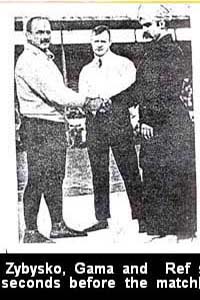
famous Polish wrestler Stanislaus Zbyszko came forward and shake hand with him
to congratulate on his victory. An announcement was made that Zbyszko and Gama
would meet in a month’s time, September 10, at the Shepherd’s Bush Stadium. And
on behalf of Gama a challenge was issued to the world champion Frank Gotch.
Gotch’s agent, who happened to be present, said that Gotch would be happy to
meet any wrestler who visited America.
Gama become popular in London as he had defeated
around 200 wrestlers. Then in White City, London, England he competed for
WORLD CHAMPIONSHIP belt held at the Shepherds Bush Stadium. And within the next
1 month Gama finally met Stanley Zbysko in the Final. On September 10, 1910,
Gama wrestled Zbysko for more then 2 hours in the Catch as Catch Can wrestling
match but the match remained undecided. The match lasted for 154 minutes. As for
remembering the Zbysko versus Gama match in our memoirs, the two grapplers
firstly met in 1910 and then in 1928. The first time, Gama Pahalwan was touring
Europe with a carnival troupe and Zbysko was one of the few “world champions” of
Europe at the time to step forward and accept Gama’s challenge. However, Zbyszko
found himself severely outmatch, and hugged the match for nearly 2 hours, until
darkness sets in and the match was called off. Both guys were to resume the
match next week on 17th September 1910 but Zbysko didn’t turn up. For some
anonymous reason the former world champ remained absent that day. Therefore the
Judges awarded the WORLD CHAMPIONSHIP BELT to Gama for overall performance. Gama
defeated the former World Champion Stanley Zbysko on technical grounds after
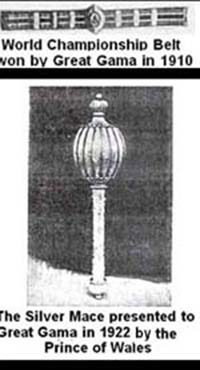
which he was crowned World Champion in London. Gama was awarded a Silver Belt by
the wrestling management in London. He was also presented a Bronze Indian Trophy
called GURZ. The Gurz is the symbol of Rustam-e-Zaman (Indian World Champion).
Gama crowned a world champ by a wrestling federation of the past and was
recognized accordingly in India and England. But not recognized by any of the
presently surviving wrestling alliances. The official world heavyweight title
history below shows Stanislaus Zbyszko as the 2 time’s world heavyweight
champion in the American and Asian circle but doesn’t show Gama Pahalwan
anywhere.
The World Heavyweight Title history (American and Asian
version):
1901 George Hackenschmidt, # 1908 Frank Gotch Chicago, IL Retires
as champion in 1913. # 1915 Charlie Cutler #1915 Joe Stecher (3rd time). #
1916 John Olin, # 1917 Earl Caddock, #1917 Ed "Strangler" Lewis (6 times
world champion) # 1920 Joe Malcewicz [2 times], #1921 Stanislaus Zbyszko (2
times world champion) , # 1925 Wayne Munn, # 1935 Danno O'Mahoney , # 1935
Dick Shikat, # 1936 Ali Baba.
When Gama
returned from England in he was the World Champ and the solely recognized
Rustam-e-Zaman of the Indian Subcontinent. While Rahim Baksh Sultaniwala was
the Indian Champion. In 1911 the 33 year old Gama met the 46 year old Rahim
Baksh Sultaniwala in the arena for the 4th time. The bout commenced at the
Industrial exhibition in Allahabad, between the world champion and the Indian
Champ to decide who's the best. Gama was at his prime while Rahim Sultaniwala
was getting old. This was the only opponent whom Gama had not defeated yet.
Both men fought aggressively throughout the match. The match preceded swiftly
holding thousands of spectators in a state of shock and suspense. In the 43rd
minute Gama attempted a maneuver that just worked fine and Rahim was thrown off
balance. He hit's the floor with a thud, and Lost the Match. Some people who saw
this match claim that he accidentally broke his ribs by hitting the pole hard
during this fight.. Later When Maharaja Bhopinder Singh went to France for
treatment Gama was working for him in India. Singh met Patterson in Paris. He
wanted to fight Gama.Therefore he came to India.
In his personal
life Gama was a loving father. During the following years Gama Pahalwan (Noonwala)
had five sons and four daughters. None of his sons survived to become a wrestler
like him. They all died young therefore Gama focused himself on the training of
his nephews the Bholu Brothers of Wrestling as long as he lived.
There were
times, when the sport of wrestling was very popular in the Indian Subcontinent.
Wrestling was a part of the Indian culture and the legendary Indian grapplers
ruled the wrestling world. Some of them were the most dominant force in the
game. India was a tough place to wrestle and the resident champions like Bholu
Pahalwan, Aslam, Gama and Imam Baksh were believed to be the most superior on
the planet.
|